


The World is Jagged
The era of the mega-star – artists like Madonna, Taylor Swift or Coldplay – may be fading, as local music is increasingly taking market share from global hits. Why? First, the biggest artists could once make much better music than the average person because the production technology was expensive. That’s no longer true. Thanks to inexpensive software, local music is now often indistinguishable from mainstream tracks from a production standpoint. Second, distribution used to be costly for small artists (think shipping cassette tapes or CDs around the world, along with promotional costs). Now, musicians can market and distribute their work to fans essentially for free using social media like TikTok and streaming platforms. As a result, people are listening to more and more music from their own countries.
For instance, in Asia, Western and Korean pop (K-pop) once dominated, but streaming platforms like Spotify now show local genres gaining share in countries like Indonesia, the Philippines, and others.

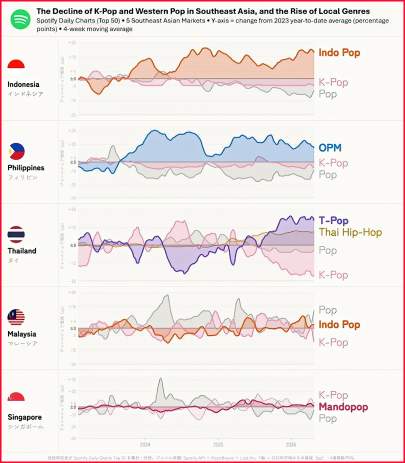
For decades, American culture spread globally through music, movies, and large brands like McDonald’s and Pepsi, gradually homogenizing cultures. The New York Times columnist Thomas L. Friedman wrote a well-known book that touched on this idea back in 2005 called The World Is Flat. His thesis was that as people around the world wore the same brands, listened to the same songs, and watched the same media, global cultures would increasingly flatten or begin to resemble one another.
But the flattening of cultures worldwide turned out to be dependent on the advantages of scale. Multinational companies across most industries had major advantages in technology, production, distribution, and marketing that allowed them to outcompete smaller firms worldwide. What’s fascinating is how technological advances have now made it much easier for local companies (and even musicians!) to create and distribute competitive products. These smaller producers also have something the larger players lack – authenticity and a human connection to the cultures in which they operate.
In a sense, while scale enabled large companies to flatten cultures across countries in the post–World War II era, technology is now reversing that process in many industries, potentially allowing cultural differences to widen. The world is increasingly jagged.
This shift will create clear winners and losers. In music, major record labels will continue losing share to local artists. The same localized trend is beginning to appear in movies and TV series, though scale still matters there since producing high-quality shows remains expensive (at least for now, though AI may change that). Similar dynamics are playing out across packaged food, alcohol, restaurants, hotels/travel, beauty, and news media, where demand is becoming more local. Many global brands that once benefited from scale are now losing ground (think Kraft cheese or Budweiser) while some companies have adapted by acquiring local, “authentic” competitors in international markets.
In an increasingly jagged world, the middle gets squeezed. From an investment standpoint, it’s best to avoid mediocre global brands that previously depended on scale to fend off local competition. The safest bets are luxury products with true global cachet that transcends cultures (think Ferrari or Rolex) or businesses where scale still matters (technology isn’t meaningfully lowering production or distribution costs) – for instance, industries like semiconductors, construction equipment, or pharmaceuticals.